THE BOOK
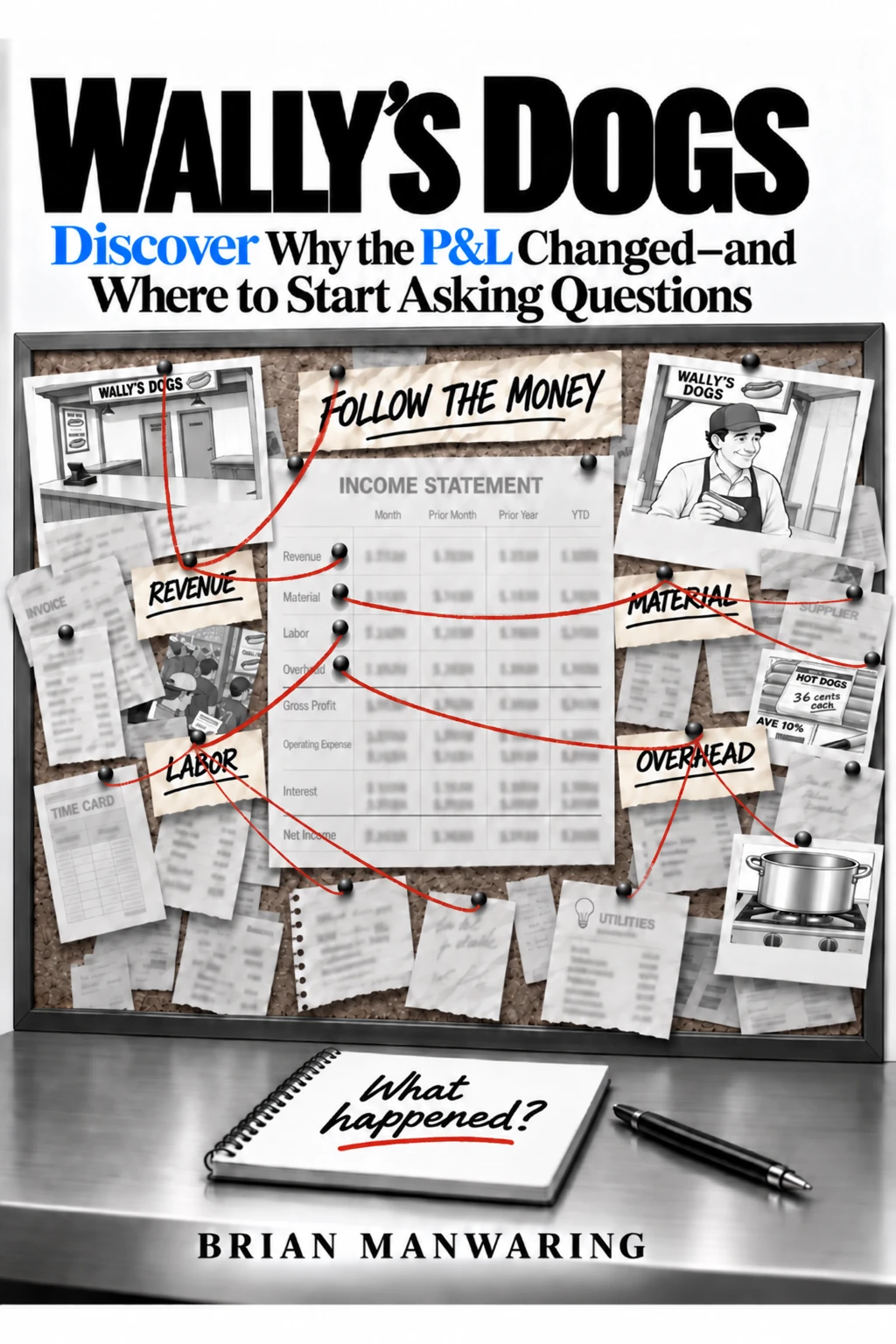
WALLY'S DOGS
Discover Why the P&L Changed—and Where to Start Asking Questions
Wally runs a hot dog stand. When the income statement changes, he learns to stop staring at the total and start investigating the pieces.
The goal is not to turn the reader into an accountant.
It is to make the income statement useful enough to recognize what changed and know where to begin asking questions.
It is to make the income statement useful enough to recognize what changed and know where to begin asking questions.
PublisherBetween The Rows Press
Paperback ISBN979-8-234-23208-3
Websitewallysdogs.com
WHAT THE BOOK DOES
Build the statement in pieces, then learn to investigate it.
PART I — FOLLOW THE MONEY
See the basic statement.
- Revenue, Material, Labor, Manufacturing Overhead, Gross Profit
- Price and Volume
PART II — FIND OUT WHY
Move beneath the lines.
- Volume and Labor
- Fixed and Variable Overhead
- Material Price and Usage
- Scrap, Yield, and Product Mix
PART III — READ THE RESULT
Compare results without stopping at dollars.
- Dollars and percentages
- Gross Profit and Gross Margin
- Budget, Variance, Favorable and Unfavorable
PART IV — RUN THE STAND
Put the pieces back together.
- Budget and Forecast
- A decision during the game
- Read the whole income statement
THE READER PROMISE
By the end, you should have better first questions.
- Read Wally's simplified income statement through Gross Profit.
- Separate Price, Volume, Product Mix, Material Price, Material Usage, Labor, and Overhead effects.
- Read dollars and percentages together.
- Compare Actual with Budget and understand Variance and F/U.
- Recognize that an income statement tells you what happened financially—not automatically why it happened or whether a decision was wise.
- Know where to begin investigating instead of jumping to a conclusion.
OPTIONAL ADDENDUM
Recognize what comes next without turning the book into an accounting text.
The main story stops at Gross Profit on purpose. The addendum continues down the page to terminology such as SG&A, Operating Income, depreciation, interest, taxes, and Net Income, and briefly introduces timing and applied-cost distinctions.
NOT THIS BOOK
Deliberately narrow.
This is not comprehensive accounting training, a journal-entry guide, a promise to make someone a finance expert, or a substitute for the company’s own accounting policies. The simplification is the point: make the relationships visible first.